The Trust Dividend
The 2026 UK Advertising Landscape Study | Post #3

My two daughters (now aged 21 and 13) barely know what a linear TV schedule is.
To them, the idea that you’d sit down at a fixed time to watch a fixed programme, and then wait through whatever comes next, is genuinely charming. Like a museum exhibit of how old people used to live. They grew up with an abundance of choice and have learned to be selective. YouTube, Netflix, Prime Video, every on-demand channel and service ever built.
Control is their default.
And yet when we watch linear TV together – it happens about once a year – they lean in during the ad breaks. Curious. Attentive. I don’t remember doing that when I was their age. I remember tuning out, running to the kitchen to find something to eat. I’ve been thinking about why that is.
My generation grew up with 3 or 4 broadcast channels, dominated by a BBC without advertising, and a cultural expectation that commercials were something you endured. We were trained to be sceptical of the sell and that scepticism runs deep. It shows up in every piece of research ever done on British audiences.
My daughters grew up differently. YouTube pre-rolls. Instagram stories. Mobile game ads every 90 seconds. They have likely seen more advertising by the time they hit their early teens than I had seen by the time I turned 30. And somewhere in that saturation, they developed something I didn’t have at their age: taste — a nose for the difference between advertising that respects them and advertising that doesn’t.
That context matters for what the Advertising Landscape UK study found about trust.
What the data actually shows
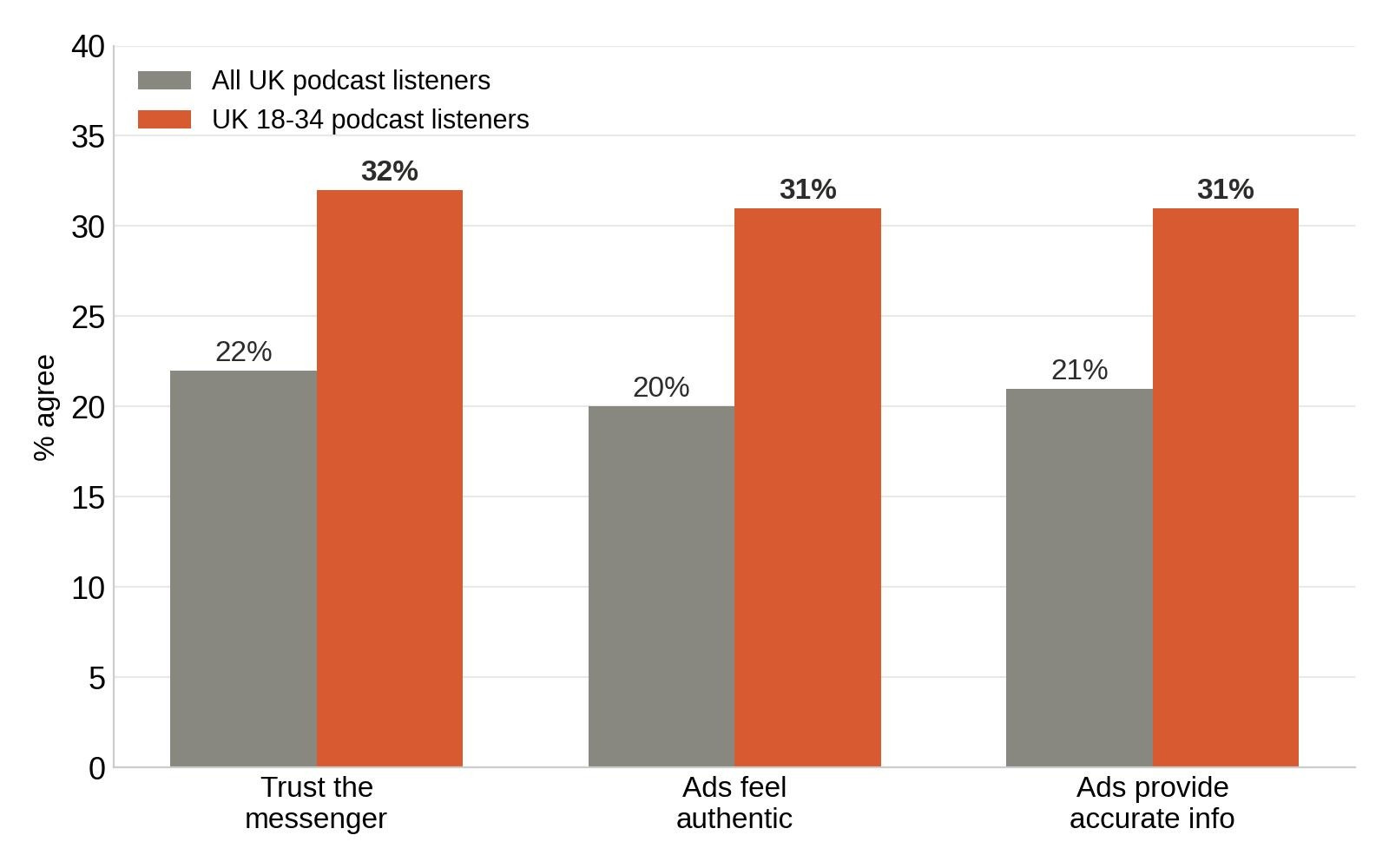
Among UK podcast listeners who use the medium daily, 22% trust the people delivering the advertising messages. 20% find podcast ads authentic and natural. 21% believe the information in those ads is accurate.
By the standards of the US data, these figures look modest. American podcast listeners score meaningfully higher on every trust dimension. The UK, as any British marketer already suspects, is a harder room.
But look at what happens among UK 18-34 daily podcast listeners specifically.
Trust in the messenger: 32%. Ads feel authentic: 31%. Ads provide accurate information: 31%.
Every attribute jumps around 10 points compared to the all-ages figure. In a market where advertising scepticism is structurally higher than anywhere else in the developed world, the youngest adult generation is the most likely to trust what they hear on a podcast.
Chart 1: The Youngest Generation in the UK is the most likely to trust what they on a podcast
Now look at what social platforms score on the same measure. TikTok ad accuracy in the UK: 2.8 out of 5. Instagram: 2.7. Facebook: 2.4. These aren’t just lower than podcast scores. They’re lower than their US equivalents by margins that suggest something beyond cultural response style. The UK-US gap on TikTok ad accuracy alone is 1.1 points. For Instagram it’s 0.9. For Facebook, 0.8.
Chart 2: Yet the Youngest UK Generation is even more sceptical than the US for ads on Social Media
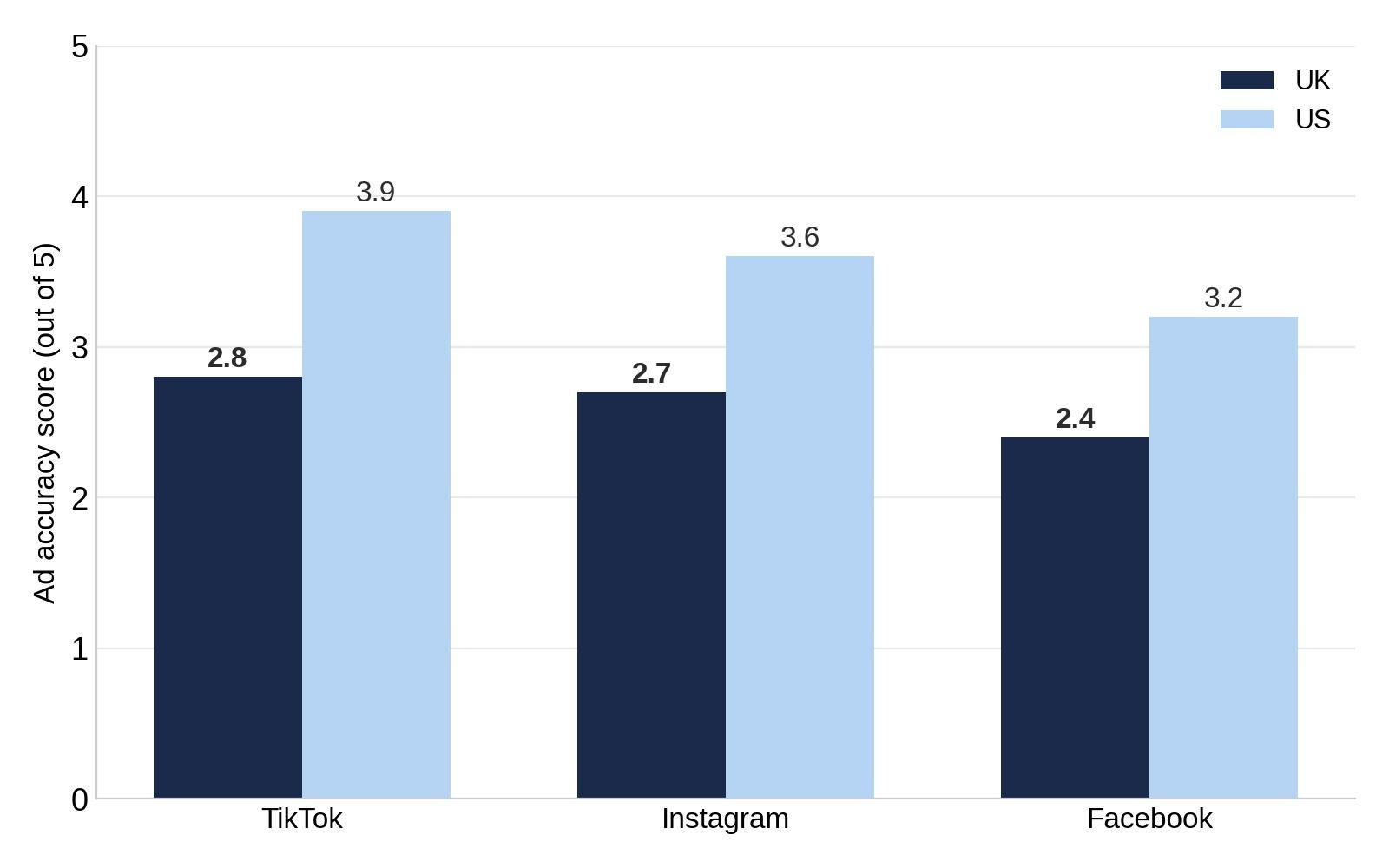
UK audiences are applying a stricter filter to social advertising than their American counterparts. And it’s the youngest adults applying it most sharply.
The real paradox
Here’s what I think is happening.
The generation most saturated with advertising is also the generation best equipped to recognise when it’s genuine. They didn’t grow up trusting everything they were sold. They grew up developing a finely tuned sense for what passes the test and what doesn’t. Pre-rolls don’t pass it. Interstitials don’t pass it. A host they chose, speaking in a medium they opted into, recommending something they say they actually use: that passes it.
The BBC trained my generation to expect something for nothing. Decades of licence-fee content built a cultural muscle for rejecting the commercial transaction. My daughters don’t have that muscle in quite the same form. What they have instead is sharper pattern recognition for authenticity. A century of public broadcasting made the UK advertising-resistant. A childhood of ubiquitous digital advertising made the next generation advertising-selective.
And podcasting, almost by accident, built itself on exactly the qualities that selective audience rewards. A host with genuine expertise. A relationship built over years. An ad that arrives in a voice you trust rather than a format designed to catch you off guard.
What the slide from our Podcast Show presentation said
“UK podcast advertising sits at a trust paradox. Listeners trust the channel and the people on it. The buyer ecosystem hasn’t yet metabolised that fact.”
Less than 5% of UK audio advertising spend currently goes to podcasts.
The 18-34 audience trusts podcast advertising at rates that outpace every social platform we measured. They’re also the generation moving through peak purchasing years. And they’re already here, already listening, already leaning in.
The UK isn’t an advertising-resistant market that podcasting is slowly softening. It’s a market that has always rewarded the advertising that earns its place. Podcasting earns its place.
In the next post: what happens after the trust is there. Purchase behaviour, age breakdowns, and the number from the data that TikTok’s headline figure would rather you didn’t see.
This is the third of five posts unpacking the study. If you want the full picture — all five posts as they're published, the press coverage so far, and the original Podcast Show presentation — I've put everything in one place: the UK Advertising Landscape Study page on the Sound Insights site.
The 2026 UK Advertising Landscape Study was conducted by Sound Insights in partnership with Sounds Profitable. Fieldwork ran February 2026 with n=5,033 UK adults aged 18+, weighted to census.